

Three Major Challenges for Camino Pilgrims
There are three major challenges for aspiring Camino de Santiago pilgrims to accomplish before boarding the flight to Spain. They are much easier to accomplish for some than others. The first, which held me back for years, was figuring out how to pay for it and leave work and kids for almost two months. The second major one is getting into shape physically, which I was starting on very late, given my bookworm, sedentary lifestyle. The last and of equal importance to your success is to figure out what you will need for a 500-mile, 6-week walk and balance it with how much your body can carry day after day. Actually, the most critical step for this is to figure out how much you can leave behind. And to keep in mind the strong warning to “not carry your fears,” in anticipation of every possible eventuality.
Now that I finally had the funds and time and had embarked on my physical training, it was time to gather new gear and clothing and then practice lifting it. I needed to lift it not once, but hour after hour, every single day for 45 days.
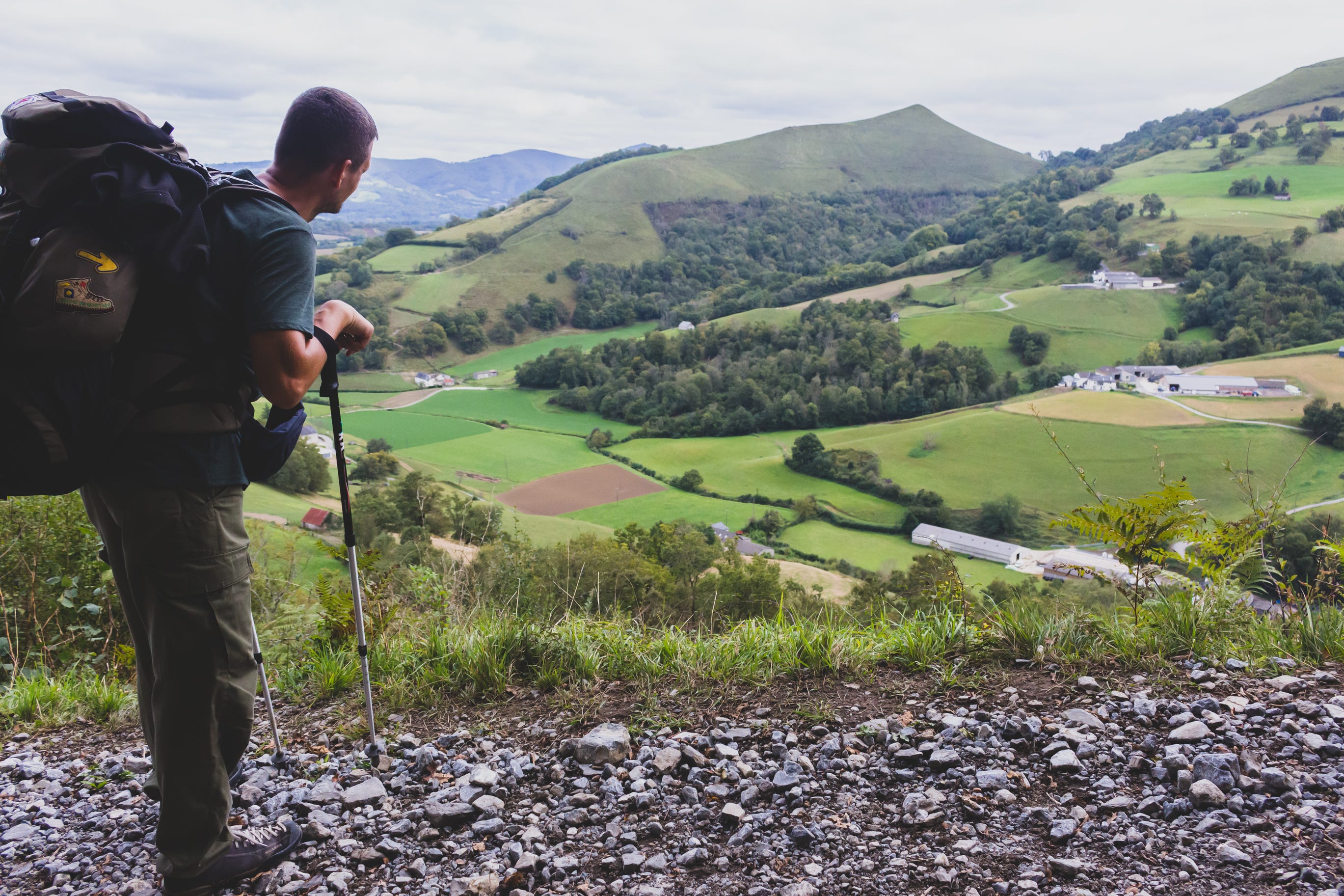
The List of “Essential Items”
Overwhelm, with a tinge of fear flooded through me as I looked at the long list of “essential items” I had jotted down from the “Pack Light” presentation at the American Pilgrims on the Camino conference and at Anita’s the Q&A session at the closest Southern California chapter, I’d just attended. I wondered, how can I possibly fit everything I’m going to need for six weeks into a backpack that I would be strong enough to carry?
So far, this was my list.
Backpack
Hiking poles
3 shirts, 2 short sleeved and 1 long-sleeved
1 lightweight warm pullover
2 Nightgowns
2 pairs of underwear, 2 bras, 2 pairs of hiking socks
Hiking Pants, Hiking shorts
Something to wear in the evening
Rain poncho and rain cover for my backpack
2 hats, 1 for sun, 1 for rain
Light gloves, sunglasses
Hiking boots, everyday traveling shoes, sports/shower sandals
Small plastic bags
Pillowcase, sleep sack, small quick-drying towel
Hiking poles, headlamp, pen, journal
Water bottle, prescription meds
Small containers of soap, shampoo, toothbrush and paste, deodorant, laundry soap
Sunscreen, small roll toilet paper, facial tissue, clothespins, bedbug spray
Smart phone and adaptive charger
Guidebook, passport, Pilgrim credential
I glanced at the title of a recommended book, “Camino de Santiago: To Walk Far, Carry Less,” (Jean Christie Ashmore, 2011) and then remembered the practical warning at each presentation, “Each ounce of weight in your pack will feel like a pound on your joints.”
Besides my worry about how I could do this, I also worried about the cost. I knew the probable cost of my flight and had estimated what I’d spend for basic lodging and food, but it was going to add up. I decided to get the shopping done and then budget the rest of my funds. I was also curious about what it would feel like to use hiking poles on my attempt to climb closer to the top of Santiago Peak that week, and I wanted to start practicing.
The nearest REI store was about an hour away. I knew that it carried a wide variety of recreational outdoor sports gear and active clothing, but I had never walked into one before. The store was immense, with high ceilings and an odd combination of earthy aromas and rubber. Signs directed customers to areas for cycling, camping, snow skiing, skating, rock climbing, soccer and on and on, adventures that I would never take. A man with a friendly smile and green vest came up to me, “Looks like you could use some help. What do you need?”
“Hiking gear, like poles, clothes and a backpack.”
He asked, “What kind of terrain will it be?”
“Well, it will vary, sometimes rocky, sometimes dirt and sometimes pavement. Crossing over mountains and walking through a long plain.”
He said matter-of-factly, “Well, you must be walking the Camino de Santiago. Right?”
I nodded, surprised that he guessed so quickly. When I first yearned to walk the Camino, I was working on my MA in Spanish Literature in the 70s, and then the medieval path was long-forgotten and overgrown. I remembered that the movie, “The Way,” starring Martin Sheen, had been released the year previous year, introducing the power of walking the Camino to thousands who would have never known about it.
The REI guy fitted me for a backpack and hiking poles, and then we moved to clothing and rain gear. Each item needed to be featherweight, so light that the trainings recommended using the precision of a postage scale.
He handed me a long-sleeved pullover, “just see how light it is. It breathes, notice all the little holes? It blocks out the wind and even shields you from ultra-violet light.”
We moved on to all the incidentals, like a light-weight towel, bed liner and headlamp. He patiently worked with me for a couple of hours.
As I lifted my bags from the cart into the car, I was surprised at how heavy it all was, though it was labeled “lightweight.”
Rather than feeling reassured by getting the gear and seeing what I was dealing with, on the long freeway drive back, I ruminated about how and if I could possibly make all this work.
An early, slightly silly scene in “The Way” shows Martin Sheen at the start of his walk over the Pyrenees, in St. Jean Pied de Porte in France, where I was also planning to begin, falling backward onto the floor when he attempted to lift his overweight backpack onto his back. I could not let that happen to me.
About halfway home, I thought about the guidance to aim to carry no more than 10% of my body weight. I remembered my current weight, 160 pounds, and for the first time I was happy that I was this heavy. The idea popped into my head that if I gained a few pounds, I could qualify to carry more weight. Fortunately, I remembered that the whole point of the percentage guideline was to have less weight pressure on my joints, no matter the source. Very dumb idea.
I sighed deeply, as I turned into the driveway, aware that trying to trick the backpack vs. weight percentage stats by gaining weight was only going to hurt me and the aging joints I was depending on to carry me through all 500 miles.
Love it, Victoria ... especially your thought that if you weigh more, you can pack more! 😂🤣😂 I may have had that thought too, lol. Yes, figuring out what to put in that pack was the ultimate Rubik's Cube. I am curious: you packed nightgowns? I just slept in the next days' outfit.
I think I got my pack down to 14.5 pounds and I was so thrilled. I would bring even less next time, knowing there are pilgrim supply shops and pharmacies all over. That long packing list that we all got faced with ... lol, that was our first "crossing of the Pyrenees!" Did you wind up abandoning any gear anywhere, I wonder?
Victoria, love this. We are sisters in backpack math. Reminds me of my first group backpacking trip through Carson National Forest in New Mexico for three weeks. I was in 8th grade, and my outdoor experience amounted to a week at Merrywood Day Camp. My mom's only interest in the outdoors was the sidewalk leading to the car, so she said nothing when I packed a change of clothes for each day and multiple pairs of shoes (just in case). Lord, I think my pack weighed about 50 pounds, especially when I volunteered to carry the group's sugar. Sadly, I left a trail of sweaters and jeans across the New Mexico wilderness. :-)