

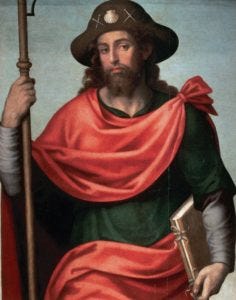
Iberian Invaders
At the time of the Apostle James’ burial in Northern Spain, the Iberian Peninsula had been invaded by the Romans and many diverse groups, including Germanic tribes, including the Visigoths. Not encountering any unified resistance, the Visigoths moved in easily and organized the foundations of a strong government. They gradually converted to Christianity and made inroads into the regional pagan beliefs during the 5th to 8th centuries. The northern area, now known as Galicia was heavily influenced by the Celtic culture and many of the traditions, symbols and music still survive.
In 711 CE a Muslim military force crossed the Straits of Gibraltar from Northern Africa and invaded the peninsula from the south. The Visigoths were by that time experiencing infighting and drought, enabling an easy conquest by the Moors, who named their new territory, “Al Andalus.” Although the invaders conquered territory as far north as France, many Christian groups survived in hiding and began to band together to gradually move south, to form what was called the “Christian Reconquest. It was an effort that would last 800 years.
Celestial Music and Stars Lead to St. James
In 812 or 814, in the region where James was buried, a Christian hermit named Pelayo, hearing celestial music, looked up into the heavens and saw bright lights that led him to a cave on a hillside. Understanding the significance of the stars, he was drawn to excavate the area and dug up three intact bodies. He reported his experience and discovery to the local bishop, Teodomiro, who accompanied him to the site and declared the non-decomposed bodies as belonging to St. James and two of his disciples.
The timing was surely Divine Synchronicity because many believed that the Muslims’ great success in the many battles to conquer Spain was due to having one arm of the Prophet Mohammed to carry with them into battle. Now, the Christians had an entire sacred body.
First Royal Pilgrimage to Santiago
A small chapel was built to enshrine the three bodies and pilgrims started arriving to honor St. James and in hope of healing, protection, freedom, blessings, and a reduction of time in spent in Purgatory. King Alfonso of Asturias made the first royal pilgrimage between 818 and 842 and in 950, a French bishop was the first pilgrim from outside Iberia, traveling on old Roman roads and crossing the Pyrenees. (Bahrami, 503).
Fisherman, Disciple to Fiery Warrior on a White Horse
Within a few years, James experienced a dramatic metamorphosis from his humble life on earth as a simple fisherman and failed preacher to become a fierce leader, leading the Christians to victory. In the legendary battle of Clavijo, in 844 (so “legendary” that now it’s doubted that it ever occurred) he appeared in the sky as a warrior on a white horse, swinging a spear at hundreds of Moors. He was now “Santiago Matamoros,” the “Moor-slayer,’ leading the Reconquest of Spain. Centuries later, his fiery image would be used to drive out the long-established Jewish population and to claim the New World for Spain.
Mohammed was said to have ridden a white horse into heaven, so now the Christians had Santiago on a white horse. (More about this later.)
Sources, Iberia, Michener, The Pilgrimage Road to Santiago, Gitlitz and Davidson, Camino de Santiago: Sacred Sites, Historic Villages, Local Food & Wine, Bahrami.
I really enjoy that you are providing background information and history details. It is adding a deeper dimension to your presentation. It is paving the way for your personal story of your road to Santiago.