

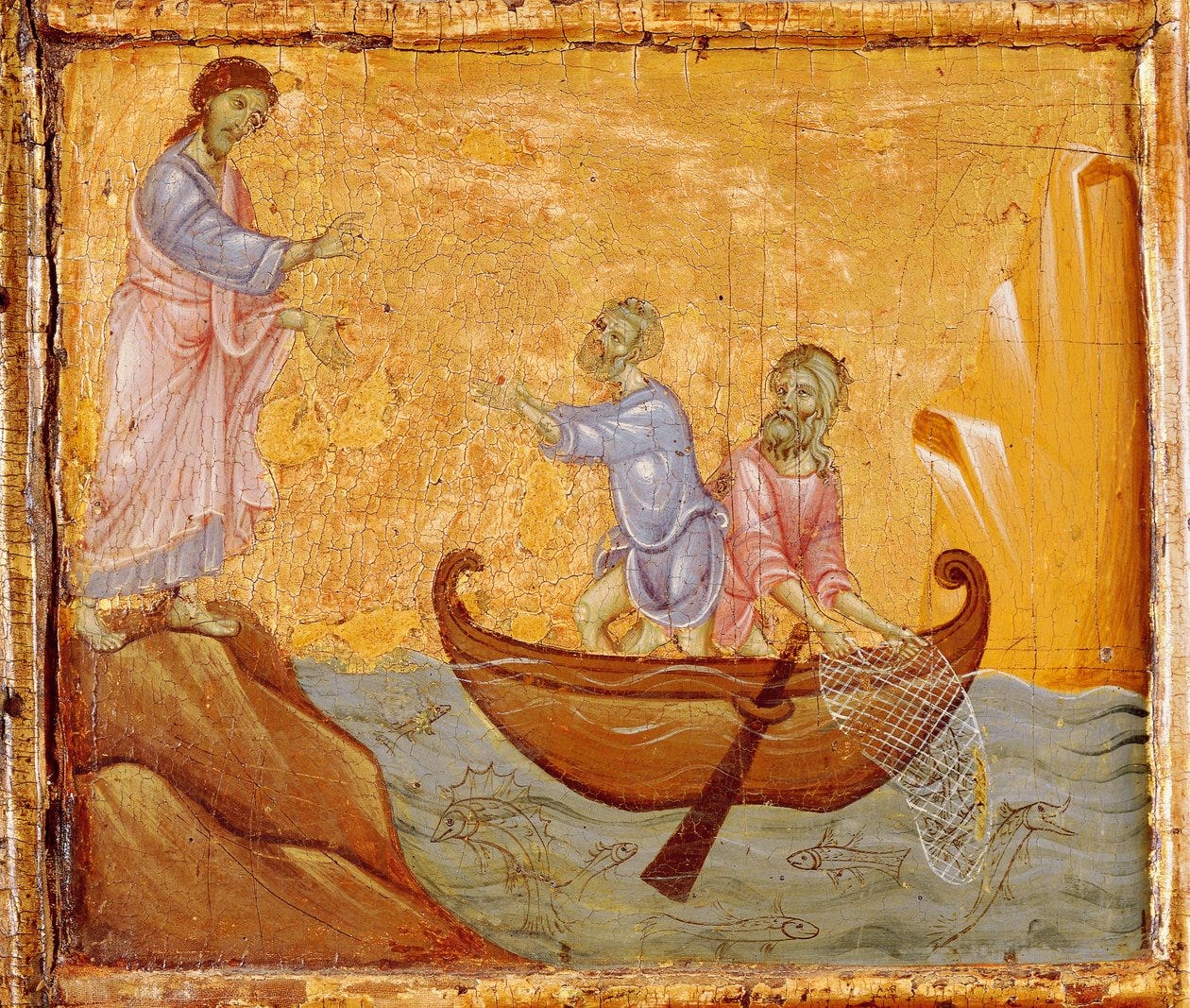
Jesus Inviting his First Disciples-A New Testament Story
As Jesus began preaching his message- “Repent, for the Kingdom of Heaven is at hand,” he started inviting men to join him to help to spread the new gospel throughout the Land of Israel. As he walked by the Sea of Galilee, he saw two sets of brothers fishing. He called out to the first two, Peter and Andrew, as they were casting their nets,
“’Follow me, and I will make you fishers of men’ and they immediately left the nets and followed him. Going on from there, he saw the others, James and John, mending their net with their father.” Matthew 4:17-22
Although their volatile tempers had earned them the nickname, the “Sons of Thunder (See Alternative Version),” he called out his invitation to them, too.
“They immediately left their nets and their father, Zebedee, and followed Him, as He traveled “about in all Galilee, teaching in their synagogues, and proclaiming the gospel of the kingdom and healing every kind of disease and every kind of sickness among the people.”
Traditions & Imaginative Legends
Knowing that his time on Earth was limited, Jesus divided up the known world among his disciples, twelve by now, to ensure that his message would continue to spread. He delegated the Iberian Peninsula to James and sent the others to Ethiopia, India, Persia, and Armenia.
James, the Fisherman, Goes to Spain
After Jesus’s crucifixion in 29 C.E., James landed on the coast of what would become Spain, sailing as far north as Galicia, along the northern coast and just east of the territory that would become Portugal. The Pagans had little interest in hearing the New Gospel of Jesus and James was only able to win over seven followers to Christianity. Feeling a failure, he decided to return to the Holy Land. There is a strong tradition in Spain that as he made his way south, an apparition of Jesus’ mother, the Virgin Mary, visited him in Zaragoza to acknowledge his accomplishment, presenting him with the column that Jeus had been tied to during his flogging, before being hung on the cross. This excruciating scene is often artistically portrayed as the Christ at the Column or the Scourging at the Pillar.
She also asked James to oversee the construction of chapel to honor her son. He delayed his journey till the completion of “La Iglesia de la Virgen Pilar,” Pilar becoming inspiration for the common women’s name throughout the Hispanic world.
James, the Failed Preacher, Returns to Jerusalem
James then sailed back to Jerusalem and was soon beheaded by Herod Agrippa, in 44 C.E., becoming the first disciple to be martyred, the only story of martyrdom mentioned in the Gospels.
“Now about that time Herod the king laid hands on some who belonged to the church, in order to mistreat them. And he had James the brother of John put to death with a sword.” Acts 12:2.
While heaven did not intervene to prevent James’ beheading, his dearest friends did find that his head had been restored to his dead body when they exhumed him in great secrecy to return him to Spain for a proper burial.
Voyage to Spain on Ship of Stone
Once they successfully got him to the port at Jaffa, heaven did get involved, providing a ship made of stone, with no sails, oars or sailors that silently made its way across the Mediterranean Sea, past the Strait of Gibraltar and then turning north along the western coast of what later became Portugal, past Finisterre, meaning the End of the World, to arrive after a seven-day journey, at Iria Flavia, the northern port of Galicia, now known as Padrón. Somehow, James’ small group of disciples somehow knew to meet the boat. Temporarily, to allow time to find a proper burial place, they lifted his body off the boat onto a flat boulder, which immediately curved to envelop the body.
Miraculous Burial
Unable to find a suitable location, they resorted to inquiring at the palace of the regional Queen Lupa. She agreed to provide a burial plot if they could accomplish several feats. Somehow, each time, the disciples met the challenge. She was impressed, yet she still demanded one more trial. If they were able to yoke two fierce, untamed, wild oxen, they could carry the body to a nearby hill to be buried. Heaven helped again, by calming the animals. As if they had the sense that the body was holy cargo, they peacefully surrendered and voluntarily placed their necks in the yoke and gently sauntered up the hill.
There, in an unmarked cave, James would lie undisturbed, for 750 years.
Alternative Versions of the Story
Rather than being called the” Sons of Thunder” (Boanerges) for their volatility, Jesus gave them the nickname due to their intense enthusiasm at spreading the Gospel
Interesting Aside
Salome, the wife of Zebedee, was the sister of Jesus’ mother, Mary, so James and John were Jesus’s cousins. She was quite wealthy and covered many of the group’s expenses, possibly even including the cost of the “Last Supper.” (Iberia, 715).
Sources
Iberia: Spanish Travels and Reflections, by James Michener, 1968.
New American Standard Bible.
The Pilgrimage Road to Santiago: The Complete Cultural Handbook, David M. Gitlitz and Linda Kay Davidson, 2000.