

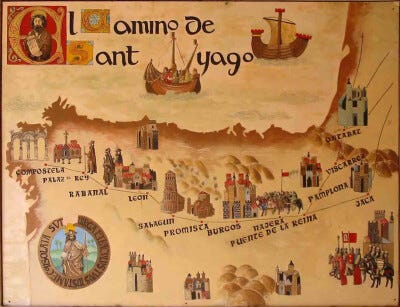
A Shrine for Santiago
The small shrine constructed to house and protect Santiago’s remains was soon replaced with larger churches, only to be raided and rebuilt over the centuries, and a steady stream of pilgrims arrived to honor him, forgiveness for their sins and crimes and to receive blessings. While many came from other places in Spain, a large percentage walked from France, Germany and Norway and Sweden and even Armenia. Others sailed to Spain’s northern coast from England and Ireland.
The era of the 10th through the 11th centuries was the height of intense veneration of relics, sacred objects or physical remains of holy people. They were believed to connect one to heaven and could bestow many spiritual benefits and often miracles. While usually relics were carefully cordoned off or covered by fabric, a tomb or glass, at the shrine at Santiago de Compostela, one could touch the altar and put one’s arms around the statue of St. James, often an emotional embrace.
The Three Sacred Pilgrimages of Medieval Christendom
The trek to Santiago joined the other two revered pilgrimages of medieval Christendom. Jerusalem and Rome. Jerusalem was significant because Jesus lived and was crucified there. Rome was important because that is where Christianity was organized and institutionalized by Constantine in the 4th century. For many Europeans, the north of Spain was a much closer pilgrimage. If you made it to Jerusalem, you were bequeathed the honorable designation as a Palmer and you would bring home a palm frond home with you to prove it. If you got to Rome, you earned the designation of Romero. Since the routes to Santiago were not well populated and filled with many hazards, and because scallops are so plentiful in Galicia, you earned the label of Peregrino/Peregrina (Pilgrim) and you came home with a scallop shell, a Coquille St. Jacques.
Rewards of Forgiveness and Assorted Blessings
Of course, emblems and new labels weren’t the main inspiration for leaving their homes for a round trip that might last a year or more and facing unknown dangers and possible death. Most of the pilgrims were devout Christians (the only form of Christianity at that time was Catholicism). Many were eager to earn what were called indulgences to release them from the consequences of their sins and spend less time after death in Purgatory, a fiery, transitional place where a soul was cleansed before being allowed into heaven. Indulgences could fortunately be shared, like coupons, with loved ones, so valuable were they to people at that time. Some pilgrims were ill and hoping for healing, so many died along the way. (They still do. On my walk in 2013, I saw very recent crosses. Quite sobering). The seeker might also be asking for healing for a loved one. Other pilgrims were sent by their villages to request rain for their crops.
For the sinners, a 13th century catalogue promised that if you completed the entire journey, you would be entitled to the remission of 1/3 of your sins. If you died and never made it all the way, you were rewarded with a total remission, your slate wiped clean. Once you were in Santiago de Compostela, if you participated in a procession, 40 days would be subtracted from your time in purgatory. If a mitered bishop led the procession, you would be released 200 days earlier. The list continued to specify the savings you earned by attending mass along the way, depending on the level of authority of the officiant and where it was located on the path. There were also lists to let you know the time savings from Purgatory dependent on how far you walked or if you rode a donkey or horse and many other specifics. (Gitlitz, 345).
Who Were the Pilgrims?
Besides these devout believers, James Michener, in his in-depth writings about Spain, Iberia, lists six additional major groups.
A second group of pilgrims were knights on horseback, with their ladies and entourage. They had promised to do the Camino if they survived a battle.
Third, there were people of the Church, like monks, priests and nuns, as well as many high-ranking clergymen, who also were hoping for blessings and forgiveness.
Fourth, there were increasing numbers of those there only to make money, by selling a variety of wares or to offer many needed services. Another common way to make money was for hearty walkers to earn the Compostela, in order to sell it to someone who needed salvation but didn’t want to venture from home.
Fifth, there was quite a large group of robbers, beggars and petty criminals. The robbers and thieves could spend years living along the Camino. The petty criminals may have been told in court to either go to jail or walk the Camino and they chose to walk.
And sixth, many were sent by other regions to report back about what was happening politically with all the incoming traffic and new developments. Other governments, from England to France and Italy were very interested in this strategic strip of northern Spain that extended from France to Portugal and had a coast on the Bay of Biscay that extended along the French coast to England and Ireland.
Legend says that Charlemagne visited the shrine, although the historical timing doesn’t match up. But then there was a succession of the rich or famous. King Alfonso 11 arrived in Santiago in 813. El Cid, Campeador, the Great Knight of the Reconquest and Spain’s national hero, came in 1064, Avery Picaud visited from France in 1130 and wrote one of the world’s first travel guides, King Louis V11, arrived in 1154 and St. Francis of Assisi in 1214. Many more were to follow.
A sequel will cover more growth, then a great decline during the Protestant Reformation when indulgences were scorned and then a resurgence of interest in the last 100 years, especially in the 60’s, leading to public complaints in 2025 about over tourism. I’m so glad I went when I did in 2013!
The Pilgrimage Road to Santiago: The Complete Cultural Handbook, David M. Gitlitz and Linda Kay Davidson, 2000.
Fascinating history about the Camino and how
Christianity used it over the centuries. I always wonder how some of these traditions evolved and who was influenced by them. Thank you for broadening this horizon for me and fellow readers. This adds to the full story you will be sharing.
I hope to make the Camino in 2027. Thinking of beginning in San Sebastion. In my early sixties, so this seems to be the best path. Looking forward to more insightful articles from you! Thank you!