

Rodrigo picked me up at my parents’ house for dinner twice during the week. My parents were curious to meet him and looked forward to having someone to talk with about Puerto Rico. He and Dad hit it off immediately, adding a few words in Puerto Rican Spanish to their conversation and talking about getting together to play a game of Dominos. I had fond memories of seeing tables set up around the plaza with older men in white Panama hats playing Dominos, so as I listened to them, I felt a warm wave of nostalgia flood through me.
After he left, Mom turned to me, “I’ve been trying to figure out his looks. They are so distinctive. He looks like he might have some Jewish ancestry.”
I responded, “Yeah, I can’t figure it out either. Must be an interesting story. I’ll ask him on Sunday, when we are walking again.”
At our second dinner, Rodrigo and I made plans to meet earlier that Sunday to buy some hiking boots and then take another walk up Skyline Drive, the dirt fire-road behind our neighborhoods. Knowing how critical it would be to have well-fitting boots to walk 500 miles, I appreciated the careful measuring of the experienced salesman, although I was embarrassed to have Rodrigo see that the salesman placed me into a men’s size. Rodrigo insisted on paying for them, which I appreciated knowing all the other gear I would need to buy, but I was surprised, so early in our friendship. Maybe it was a sign that he felt that he saw us progressing into a future together. I wasn’t sure if I could see one yet.
We started up the dirt road and soon I realized that quite effortlessly, we had already climbed farther than last time. My boots weren’t broken in yet, but I was relieved that I didn’t get a single blister. I was surprised at what a difference real hiking boots could make to prevent or at least delay them.
Rodrigo pointed up the mountain, “It’s six miles to the top of Santiago Peak. It’s worth it, because the view of the coast is incredible. If it’s not too smoggy or foggy, you can see Catalina Island. Not only that, but the ocean breeze will cool us off.”
That would be welcome. It was hot.
Then he turned and looked into my eyes, “You know, you only have four months to train. We need to get you to the top and back like it’s no big deal, by then.”
Interesting. Again, it seemed like he expected this thing to continue. I kind of liked him taking such a personal interest in my endeavor, but I still wasn’t sure about him.
“ The Baptism of Fire”
I raised my head to see the peak from under my cap. The hilly range with Mt. Santiago blocked the ocean breeze with refreshing winds from the nearby coast. An hour behind us, to the east, was the desert and Palm Springs. The view sounded enticing. I had read that pilgrims averaged 10-12 miles a day. I knew that it would be worth doing the 12-mile round trip to increase my endurance. I knew I had to be strong enough to walk those miles, day after day for 6 weeks. I’d read that the very first day of the Camino Francés over the Pyrenees, from St. Jean Pied de Porte in France down to Roncesvalles in Spain, was referred to as the “Baptism of Fire.”
A few months earlier, when I finally realized that I might be able to do the Camino, aware that I was far from being physically ready to walk 500 miles, I thought that I could start out slowly, gathering more strength to walk a little further each day. Learning now about how steep the initial incline was, it was clear that I was not going to have the opportunity to build muscle gradually. I had to be able to make it through the “Baptism of Fire” on Day 1!
I turned to him and said, “Yes, I need to be able to get to the peak and back without it killing me within a month or so. I’d better come here almost every day without you. Glad the trail is so close.”
Internal Warfare
As we continued up the increasingly steep incline, Rodrigo turned to me, “I think I should tell you that my first name is actually Drake. Rodrigo is my middle name. When I was 8 years old, my mother looked at me and proudly said, ‘Do you know why I named you Drake?’ I said, “No, it’s a strange name, my friends make fun of my name, why?” She replied, ‘Sir Francis Drake was a very famous man, I wanted you to have a noble name.’
Mamá only went through 6th grade. In high school, when I studied World History, I learned that Sir Francis Drake was most famous for being the first Englishman to sail around the world and for his leadership role in defeating the Spanish Armada. Did you know that Drake’s nickname was El Draque, the Dragon, because he was actually more of a pirate? But worst of all, he was one of the first British slave traders?!”
His voice was intense and he sounded hurt and angry. He was on a roll and kept going.
Kidnapped for the New World
We kept walking as he went on, “I’m tormented by this war inside me.” He lifted his nose into the air and pointed to it. “This proboscis and my hair came from genes from kidnapped Africans, on my dad’s side, brought to the Caribbean to work on the plantations. Dr. Feinstein, the dentist that owns all the offices where I do dental implants, doesn’t feel that my little black curls give a professional look for a surgeon. I have a hard time handling my wiry hair, so I have to spray it down. I’m still pissed about this, but just the other day, I guess I had let it grow a little, and when he came up behind me and saw curls around the base of my neck, he reached up and pulled on them. I turned around so fast and stopped myself just in time. Both of us stepped back quickly and realized how close I had come to killing him. Maybe he was teasing and thought it was funny, but he could have been dead in a minute. I saw him shaking and yelled at him, ‘Don’t you ever, ever, ever touch me again.’” Rodrigo’s face changed from rage to a slightly amused smile, “Guess I’m a little quick on the draw from my abusive childhood, teen years in a gang in New Jersey, and my years in ‘Nam.”
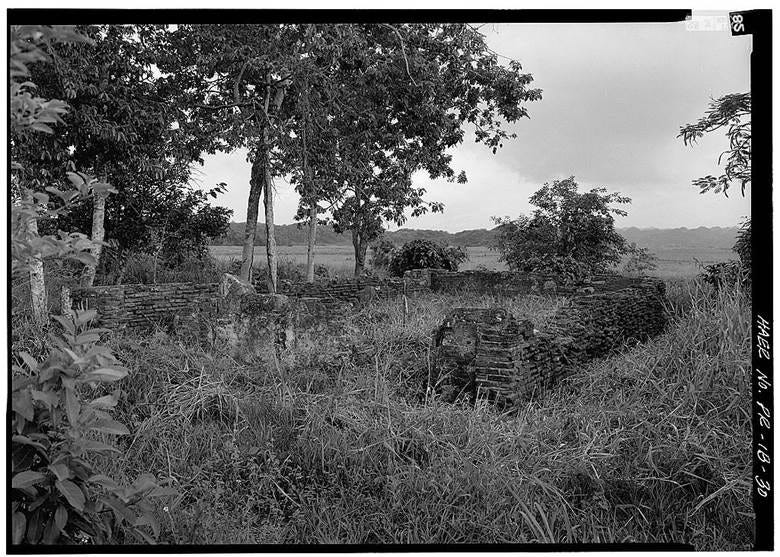
As I listened to his story, I felt his intensity throughout my own body. My heart went out to him and at the same time, I recoiled in fear. Through my years working in violence prevention education and youth mental health, I knew the familial cycle of violence that didn’t just go away without a lot of healing and he’d just showed me how quick he was to strike. I also remembered the stories of many women of my generation who had struggled to salvage their relationships when their soldiers returned from Vietnam. I felt some apprehension as I thought of a future with him.
Brave Taino Cacique
He waved his arms and went on, “I have Taino blood from Mom’s side. That DNA comes through only on the maternal side of Puerto Ricans, because when the Conquistadors landed, they killed all the males.”
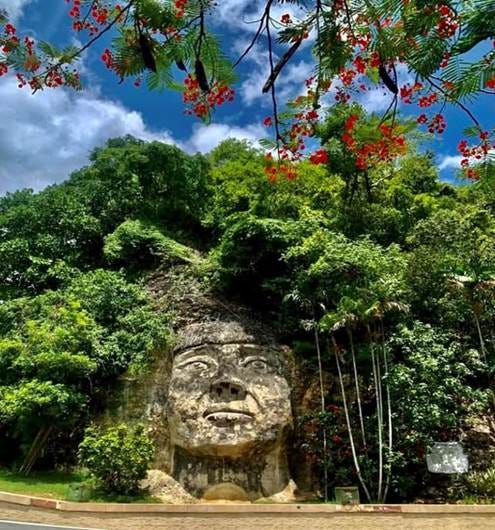
I took a good look at his facial structure as he turned and I was struck by his resemblance to the courageous face carved into a rock cliff in Isabela, Rodrigo’s birthplace by the sea in Puerto Rico. It was created to honor the great Cacique Mabodamaca, who led the Taino resistance on the northwest side of the island. Legend says that when the Spaniards ambushed his group, he chose to dive off a cliff into the ocean rather than to be captured.
Slaughter in the “Name of the Cross”
Rodrigo’s voice rose even more, “I absolutely detest my last name, ‘de la Cruz’ (of the Cross).”
I had heard what a difficult time he had saying his name when he answered the phone or made restaurant reservations. He would just mumble “de la Cruz” quickly in a barely audible voice, which caused him to often have to repeat it to the person on the other end.
“I just hate being tied through my dad’s surname and lots of Spanish DNA on Mom’s side to those despicable Conquistadors who slaughtered millions in the New World, supposedly in the ‘Name of the Cross!’” The Spanish kidnapped and enslaved the African side of my family and decimated my other side, the Tainos, and I’m also stuck with this vile last name! The soldiers killed all the Taino men, so now the DNA only comes down through the maternal genes of Puerto Ricans.”
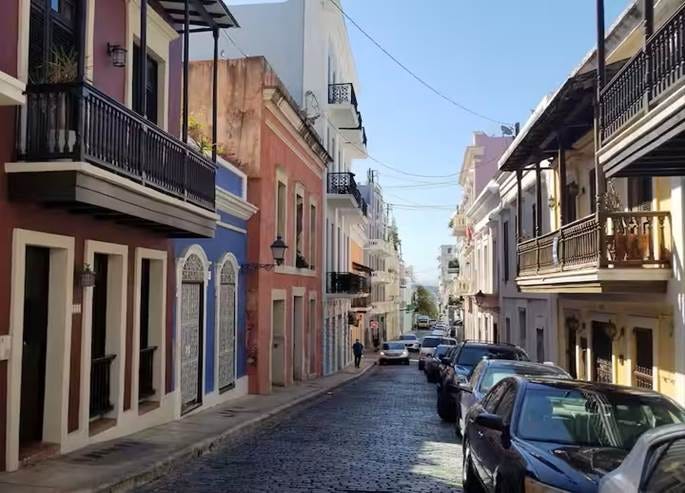
I sensed the rage emanating from his core and I grasped at least some of his deep emotional conflict. I knew well the history of it all from my graduate studies in both Spanish and Latin American Culture and Civilization and my studies of the History of the Christian Church in seminary. I felt helpless, knowing that there was nothing I could do to help it or change it, only to show my deep empathy. I remembered all the times I’d walked down the Calle de la Cruz, a prominent street in Old San Juan, just a few blocks from the Spanish fortress, the Casa Blanca, the home of Puerto Rico’s first governor, Ponce de Leon, and the cathedral holding his tomb. It was paved from the blue stones used as ballast for the Spanish galleons.
“We are all coffee, some with more milk, some with less.”
My memory went back to a conversation I heard that offered a different perspective on what the experience of being a Puerto Rican was like. Our one-room classroom for grades 1-3 classroom was on the ground floor of a small building that also housed the young nursing students. We lived in a medical missionary community around the Seventh-day Adventist hospital where my dad practiced orthopedics. We little girls loved to hang out with the teenagers upstairs. We learned all kinds of things about life, but I distinctly remember an older girl laughing at a story that someone was telling, and then turned to me to explain, “Aquí en Puerto Rico, todos somos café con leche unos con más leche, otros con menos.” (We are all coffee with milk, some with more milk, some with less.) So, this was the embracing sense that I grew up with.
Although it was so contrary to these oft repeated words throughout all Latin America, I also felt and understood Rodrigo’s history and feelings about race and shame at my core. I was deeply stirred, but it was scary, to hear how “quick on the trigger” he was. I adored his beautiful head of thick black, curly hair, which reminded me of my first little boyfriend Hector, who had escaped from Cuba with his family, and my summer camp crush, Nestor, and my other childhood friends. I’d noticed that Rodrigo’s hair always looked like it had been patted down and thickly sprayed, and vowed to myself that if I continued in this increasingly surprising and potentially challenging connection with him, I would somehow get him to stand up to his boss at the dental office and set his hair free.
At the same time, I was a little ashamed at how much I loved how he towered over me, making me less conscious of my own size and the extra pounds that had crept on through my 50s, since I realized that his height came from his Conquistador side. I still had 6th grader Vicki inside me that was so skinny and tall at 11 that she felt like Popeye’s gangly wife, Olive Oyl, already taller by then than most people, even the men, on the whole island of Puerto Rico. I had to order all my clothes and huge shoes from the Sears & Roebuck catalog. The dresses large enough to fit me in Puerto Rican shops were designed for curvy breasts, not an iron board chest like mine.
St. John of the Cross
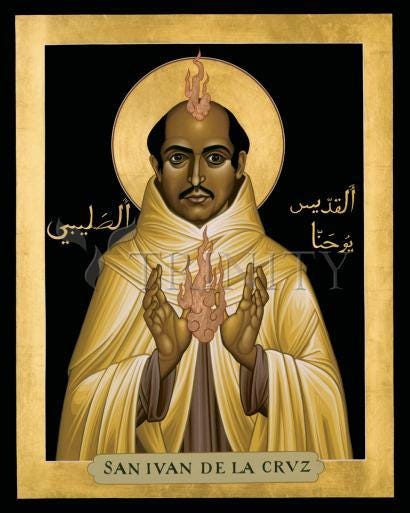
And, although I also totally understood and had compassion for his tragic association with the name, de la Cruz, mine was diametrically different. I had a longstanding deep heart and soul connection with that name, after falling in love with the writings of the 16th century Carmelite priest San Juan de la Cruz, revered for his poem of spiritual anguish, “La noche oscura del alma,” “Dark Night of the Soul,” during my master’s studies of the literature of El Siglo de Oro, Spain’s Golden Age. Even though I’m not Catholic, for years I had treasured his icon showing the great mystic’s internal flame, and had his writings on my shelf. It was hard to encompass all of it, since both were in my heart and soul and burned within me.
As started back down the mountain, I saw that had a lot to contemplate about my history and Rodrigo’s, but for now, just tried to breathe and walk, and know I was practicing for my dream come true—the Camino de Santiago.
This is so beautifully written.
Ok I am eagerly waiting for the next post. (I waited eagerly for this one!). He sounds ... a little unnerving. How did you feel about all the talk about the nose hair?! And your sense of the capacity for violence feels very astute. And buying the boots and trying to get you trained ... I feel the intensity of all of that. I am really glad you are telling this story.